US ship strike tests Tehran’s narrative of victory in Hormuz
A US strike on a container ship approaching an Iranian port has complicated Tehran’s narrative of a strategic victory against Washington over the Strait of Hormuz.

A US strike on a container ship approaching an Iranian port has complicated Tehran’s narrative of a strategic victory against Washington over the Strait of Hormuz.

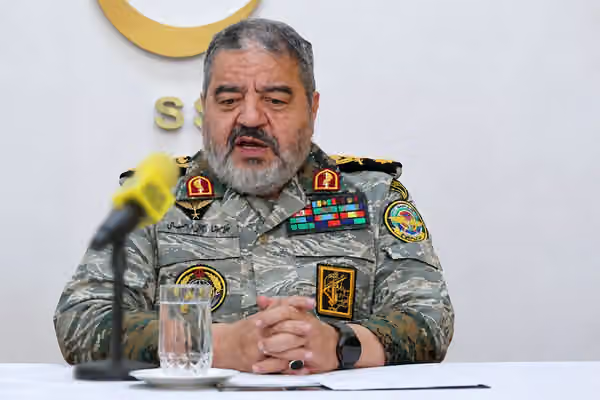
Iran's latest military appointments are consolidating its command structure after the recent war, with hardliners portraying the reshuffle as a shift toward a more unified and offensive posture.
Iran's unseen supreme leader has issued his first military decrees, raising a central question about the emerging order under Mojtaba Khamenei: is he tightening his grip on power, or relying on the old security establishment to shore up his authority?
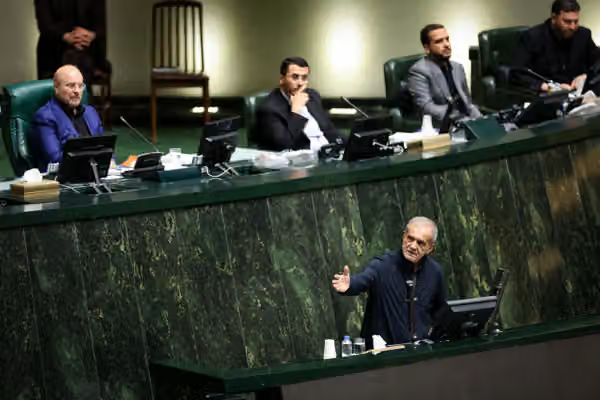
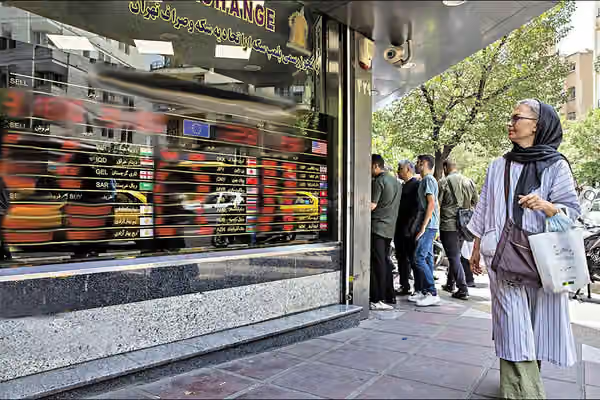
Masoud Pezeshkian may have a claim to being Iran’s unluckiest president, with his two years in office dominated by wars that have battered an already ailing economy to the point that keeping households above subsistence would count as an achievement.

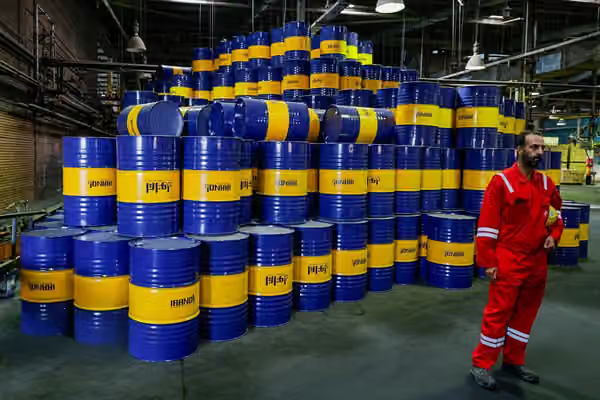
Iranian lawmakers are advancing a sweeping bill aimed at asserting greater control over the Strait of Hormuz, including restrictions on US and Israeli assets in a waterway through which about one-fifth of global oil and LNG supplies passed before the war.

Supreme Leader Mojtaba Khamenei appointed veteran intelligence official Hossein Taeb to lead the Basij, giving the former protest crackdown figure a mandate to expand the paramilitary force’s grassroots intelligence network and use of new technologies.

Iran’s Supreme Leader on Monday ordered the completion of a process to integrate the Armed Forces General Staff with the Khatam al-Anbiya Central Headquarters, Iran’s top operational military command, as he appointed Ali Abdollahi chief of staff.

Mojtaba Khamenei’s continued absence from public view has created an unusual system of authority in Tehran, where decisions are made and justified through written messages attributed to him while responsibility appears dispersed across a core establishment network.

Mohsen Rezaei was appointed as Supreme Leader Mojtaba Khamenei’s representative on Iran’s Supreme National Security Council on Sunday, before being named secretary of the powerful security body.

Hamidreza Rajabzadeh, a pro-establishment Iranian religious singer, was abducted and killed after being missing for several days, the IRGC-affiliated Tasnim news agency reported on Saturday.

Iranian cleric Mohammad-Bagher Kharrazi was summoned to the Special Clerical Court after calling for the Islamic Republic to be replaced by a more hardline “Islamic government” and outlining plans to mobilize a 250,000-strong network capable of surrounding government sites.

Iranian hardliners are intensifying pressure on authorities to enforce compulsory hijab, as recent cafe closures and online campaigns raise fears of a renewed crackdown despite widespread defiance of the dress code.

A cleric tied by marriage to Iran's ruling family has declared the Islamic Republic obsolete, telling followers that a shadow government already exists and urging them to build a 250,000-strong network to replace the system with an "Islamic government."

Iran's parliament has become all but irrelevant since the war, as power has shifted further toward the Revolutionary Guards and decision-making has moved ever deeper behind closed doors amid the unresolved leadership transition.

Iranian President Masoud Pezeshkian was taken to a secret Tehran location and allowed only minutes in a dark, tinted-window car with a man presented as Supreme Leader Mojtaba Khamenei, sources familiar with the episode told Iran International.

Donald Trump's decision to abandon a planned large-scale military strike against Iran has accelerated regional diplomatic efforts to revive US-Iran negotiations, while deepening political divisions inside Tehran over engagement with Washington.

Formal backchannel negotiations between Iranian and Western envoys resumed in Muscat on Monday after President Donald Trump suspended strikes on Iran's energy infrastructure over the weekend, even as Tehran publicly denied direct contacts with Washington.

Iran’s Supreme Leader Mojtaba Khamenei has warned President Masoud Pezeshkian that his next resignation would be accepted, a relative of Khamenei by marriage said in a video released Monday, prompting sharp denials and political backlash.

Iranian parliament speaker Mohammad Bagher Ghalibaf said authorities rushed to announce Ali Khamenei’s death and call supporters onto the streets after “overseas media” broke the news, fearing the situation on the streets could otherwise “take a completely different turn.”

A gathering of thousands of teenagers at a Tehran mall to meet a popular YouTuber exposed a widening blind spot in Iran, some sociologists suggested: a generation whose values, social lives and sources of authority increasingly lie beyond the state's understanding.

Signs of reluctance to widen the conflict are emerging in Tehran, with conservative politicians and media urging restraint even as they accuse the United States and Israel of orchestrating Ukraine's attack on an Iranian vessel.

Iran's state broadcaster has ignored a formal order from its own watchdog to stop censoring senior officials, highlighting the gap between the country's formal institutions and where authority is exercised in practice.