US-Iran deal appears close but Tehran is split and Hormuz remains tense
A US-Iran deal may be within days, but Tehran’s path to signing is being clouded by hardline backlash, disputes over nuclear terms and frozen funds, and fresh military tension around the Strait of Hormuz.
What Washington presents as a possible end to the war is being fought over inside Iran as something more uncertain: hardliners see retreat, negotiators see leverage, and officials continue to warn that confrontation with Washington is far from over.
Iranian Foreign Minister Abbas Araghchi has said a memorandum of understanding with the United States could be signed remotely if final negotiations are completed, while insisting the text has not yet been finalized and could still change.
US officials have also signaled that an initial deal may be close. Treasury Secretary Scott Bessent said Friday an agreement could come within days, possibly by the weekend or Monday. Reuters reported that the proposed memorandum would reopen the Strait of Hormuz and lift the US naval blockade on Iranian ports, with nuclear talks left for a later stage.
Pakistan’s Prime Minister Shehbaz Sharif said on Saturday a final text of the agreement had been reached and that Pakistan was preparing for an electronic signing expected within the next 24 hours. He added that technical-level talks would follow next week.
A deal still contested in Tehran
But the two sides are describing the possible agreement in sharply different ways.
Washington has framed it as a performance-based deal that would require Iran to dismantle its nuclear program, destroy and remove highly enriched uranium, and accept long-term inspections before receiving sanctions relief or access to frozen funds.
Tehran has presented the memorandum more as an interim political and security arrangement, centered on ending the war, reopening Hormuz and preserving later nuclear talks as a separate phase.
That gap has given hardliners inside Iran an opening to attack the draft before it is signed.
Kayhan, a hardline daily close to Iran’s most uncompromising faction, warned that the Strait of Hormuz must not be reopened through diplomacy with Washington. In a front-page article, it said Hormuz had been closed “with power” and should not be opened until US forces leave the region and Washington accepts the supreme leader’s red lines.
Khorasan daily went further, arguing that any deal would only delay what it described as a final confrontation between Iran and the United States. It said the real function of an agreement would be to give both sides time to rebuild offensive and defensive military strength before a wider war.
But the hardline front is not entirely unified.
The conservative daily Javan criticized those rejecting any negotiation with Washington, saying diplomacy can be part of the same confrontation rather than a surrender to it. The paper argued that governments can fight and negotiate at the same time, and said blanket opposition to talks only creates doubt and benefits the enemy.
Nuclear terms, money and side deals
The dispute has also reached parliament. A member of parliament’s presidium said any memorandum that becomes a binding agreement, treaty or similar arrangement must be reviewed by lawmakers. He also warned that no deal should violate Iran’s Strategic Action Law, the 2020 legislation that pushed Tehran to expand nuclear activity and restrict international inspections after US withdrew from the 2015 accord.
The nuclear question may now be harder to resolve than either side publicly admits.
CNN reported that Iran has sharply escalated efforts to seal off its near bomb-grade uranium stockpile, deliberately collapsing tunnels and placing explosive mines at entrances amid fears of a possible US operation to seize the material. The report said access to roughly half a ton of highly enriched uranium is now more difficult, dangerous and time-consuming, and could complicate any deal requiring Tehran to turn over the material for destruction and removal.
The money question is equally unsettled.
US officials say no frozen funds will be released simply for signing a deal or attending a meeting, and that any economic relief would depend on Iranian compliance. Reuters, however, reported that the United Arab Emirates had agreed to unlock billions of dollars for Iran under an arrangement aimed at halting Iranian missile and drone attacks on the Persian Gulf state. The UAE denied that any frozen Iranian funds had been released, transferred or facilitated.
Reuters also reported that Iran has approached at least two other Persian Gulf Arab countries seeking similar arrangements, under which Tehran would halt missile and drone attacks in exchange for economic and security understandings.
Such side arrangements point to a broader reality: even as the US-Iran track advances, regional states are trying to reduce their own exposure to Iranian attacks.
Hormuz remains the test
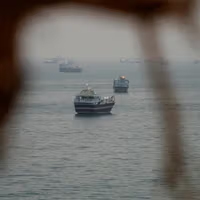
Hormuz remains the clearest test of whether diplomacy is lowering the temperature or merely reorganizing the pressure.
Araghchi said Iran’s pressure over the strait would remain in place and that Iranian forces would intervene whenever necessary. He said tolls could not be imposed under international law, but described “service fees” as part of the negotiations.
In parliament, National Security Committee Chairman Ebrahim Azizi compared a proposed bill on managing the Persian Gulf and the Strait of Hormuz to the nationalization of Iran’s oil industry, saying it would cover transit rules.
At the same time, the blockade is already affecting trade. Abbas Soufi, deputy chairman of parliament’s Construction Committee, said imports through Iran’s southern ports have faced challenges because of the naval blockade.
Military incidents are also continuing. US Central Command said Friday that Iran launched multiple one-way attack drones in an attempt to strike commercial ships transiting the Strait of Hormuz, and that US forces shot them down while traffic through the waterway continued.
The diplomacy is unfolding on a charged anniversary. Senior Iranian officials released messages marking one year since the 12-day war, using language that underlined mistrust of Washington rather than reconciliation.
Judiciary chief Gholamhossein Mohseni Ejei said Iran had “absolutely no trust” in the United States and that Tehran’s confrontation with Washington and its allies would not end.
That is the central contradiction surrounding the possible deal: the war may be moving toward a memorandum, but neither side is presenting it as peace. The closer the agreement gets, the clearer the central question becomes – can it actually reduce the conflict, or merely give both sides a way to regroup before the next confrontation?
Canada’s response to the latest Iran crisis reflects the contradiction at the heart of Western policy toward Tehran: a continued call for diplomacy with a government it simultaneously treats as a source of terrorism, repression and regional instability.
In a written response to Iran International, the Canadian government said all parties involved in the latest exchanges between Iran, Israel and the United States must comply with international humanitarian law, including the protection of civilians and civilian infrastructure.
Ottawa also stressed the need for diplomacy and dialogue to resolve the crisis. But in Canada’s case, that language does not signal a softer approach toward Tehran. It sits alongside one of the most restrictive Iran policies among Western governments, built around sanctions, terrorist designations and a long-standing diplomatic rupture.
That tension is especially visible in Canada’s concern over the Strait of Hormuz.
Global Affairs Canada said Ottawa remains worried about disruptions in the strategic waterway and emphasized that respect for international navigation rights under international law is essential. It said the free flow of maritime traffic through the corridor is critical to global energy stability and supply chains.
For Canada, the crisis is therefore not only about preventing a wider war or limiting civilian harm. It is also about protecting the rules and routes that underpin global trade, energy flows and maritime security.
That is where Ottawa’s call for diplomacy begins to narrow. Canada supports de-escalation, but not in a way that separates the current crisis from Tehran’s broader conduct in the region.
Global Affairs Canada said Ottawa will continue working with allies and partners, both bilaterally and multilaterally, to support a diplomatic solution while countering what it describes as destabilizing activities by the Islamic Republic.
Those activities include Iran’s support for terrorist organizations, its ballistic missile program, nuclear activities and systematic human rights violations.
In other words, Canada’s message is not simply that the fighting should stop. It is that any diplomatic path must exist alongside continued pressure on the structures Ottawa believes drive Iran’s regional behavior.
That pressure is not only rhetorical.
Canada lists Hamas, Hezbollah and Yemen’s Houthi movement, also known as Ansarallah, as terrorist organizations. Ottawa has accused Iran of providing political, financial or military support to such groups.
In June 2024, Canada also listed the Islamic Revolutionary Guard Corps as a terrorist organization, following years of pressure from victims’ families of Flight PS752, human rights advocates and the Iranian-Canadian community.
Since 2012, Canada has designated Iran as a foreign state supporter of terrorism under the State Immunity Act, a legal framework that allows victims of terrorism to pursue civil action against the Iranian state in Canadian courts.
Together, those measures make Canada’s diplomatic language more constrained than it may first appear. Ottawa can call for dialogue, but it is doing so with a state it has legally and politically framed as a sponsor of terrorism and a source of transnational threats.
The sanctions record points in the same direction.
In March 2026, Canada sanctioned five individuals and four entities involved in procurement networks supplying technology used in IRGC weapons production, including drone-related systems. Canada said some Iranian arms, drones and technology have been transferred to Russia for use in the war against Ukraine.
A month earlier, Ottawa sanctioned seven individuals linked to Iranian state bodies responsible for intimidation, violence and transnational repression targeting dissidents and human rights defenders.
These measures show why Canada’s Iran policy cannot be read only through its latest call for restraint. The government is trying to prevent escalation in the short term while preserving the tools it has built over years to isolate and pressure Tehran.
The relationship has been moving in that direction for more than a decade.
Canada severed diplomatic relations with Iran in September 2012, closed its embassy in Tehran and declared Iranian diplomats in Canada persona non grata. Relations have not been restored since.
The gap widened further after the downing of Flight PS752, crackdowns on protests in Iran, allegations of transnational repression, Tehran’s regional activities, and concerns over its missile and nuclear programs.
Against that backdrop, Canada’s latest response is less a change in policy than a reminder of its limits. Ottawa wants diplomacy to contain the crisis, but it has little trust in the government with which diplomacy would have to be conducted.
That is the uneasy mix shaping Canada’s approach: avoid direct military involvement, keep channels for de-escalation open, and continue working with allies to restrict Iran’s room for maneuver.
The unresolved question is whether diplomacy can contain the crisis if Tehran is unwilling to make lasting changes, or whether negotiations will again become a way to delay pressure while preserving the policies that brought the region to this point.
The Middle East may be entering a period in which ceasefires no longer end wars but manage them, as the warring sides trade limited strikes below the threshold of an all-out war, experts told Iran International’s townhall held in Washington DC.
The discussion, hosted by Iran International’s Negar Mojtahedi, centered on whether the latest ceasefire in Lebanon marks the end of a war or the beginning of a more dangerous phase: a regional conflict in which Iran increasingly treats attacks on its proxies as attacks on itself.
A ceasefire that does not end the war
Alex Vatanka, a senior fellow at the Middle East Institute, said Iran’s latest posture toward Lebanon should be viewed against the long arc of the Islamic Republic’s presence there.
He noted that it has been more than four decades since the first official officers of the Islamic Revolutionary Guard Corps arrived in Lebanon, making the country a central pillar of Tehran’s regional project.
Alex Vatanka
For years, Vatanka said, Iran used Lebanon and Hezbollah to project power, particularly against Israel. But recent events suggest Tehran may now be entering “a new chapter,” one in which the distinction between Iran and its proxy network becomes more blurred.
“An attack on Hezbollah, an attack on the Houthis, an attack on the Hashd al-Shaabi is going to, from now onward, be considered an attack on Iran,” Vatanka said, describing what Iranian officials have presented as a new defense doctrine.
He cautioned that if taken literally, such a doctrine could mean an open-ended regional confrontation. Any strike on Hezbollah in Lebanon, the Houthis in Yemen, or Iran-backed militias in Iraq could invite a direct Iranian response, turning local battlefields into triggers for wider escalation.
Vatanka said Tehran appears to be defending its proxy strategy at a moment when many analysts had expected the opposite. After October 7 and the heavy blows inflicted on Iran-backed groups, some believed the Islamic Republic might conclude that its “forward defense” strategy had failed. Instead, he said, influential voices in Tehran appear to be arguing that this is precisely the moment to double down.
Iran’s umbrella over Lebanon
Robert Satloff, executive director of the Washington Institute, said Lebanon is now caught between two competing visions of its future.
“There are two competing realities in Lebanon,” Satloff said. “One reality is Iran asserting its umbrella to control Lebanon... The other reality is Lebanon and Israel negotiating a security agreement, potentially a peace agreement.”
That contrast may define the next phase of the conflict. In one scenario, Iran tries to reassert control through Hezbollah and make clear that Lebanon remains part of its regional security architecture. In the other, Lebanon’s government attempts to reclaim sovereignty and pursue security arrangements with Israel, with US backing.
Robert Satloff
Satloff said Iran’s attempt to claim Lebanon under its umbrella has not succeeded, but neither has the effort to fully disarm Hezbollah. He described the challenge as a contest between Iran’s regional power projection and a fragile Lebanese state trying to implement commitments it has made before but repeatedly failed to fulfill.
He also argued that Iran’s latest direct attack on Israel showed weakness rather than strength. Compared with previous barrages involving hundreds of missiles, he said, the latest attack was limited and intercepted, exposing the degradation of Iran’s capabilities rather than demonstrating strategic confidence.
Hezbollah down, but not out
Ambassador David Hale, a distinguished diplomatic fellow at the Middle East Institute and former US ambassador to Lebanon, Jordan and Pakistan, said one of the most striking changes is Hezbollah’s current vulnerability.
“Hezbollah is so degraded, it's down but not out, but it's so degraded that it can't defend itself,” Hale said. “Iran is coming in to defend its proxy. It's always the other way around.”
For Hale, that reversal is significant. Hezbollah was long understood as one of Iran’s most powerful deterrent tools, a force capable of threatening Israel and shaping Lebanese politics on Tehran’s behalf. Now, he said, Iran’s direct intervention suggests Hezbollah can no longer perform its traditional role with the same effectiveness.
Ambassador David Hale
Still, Hale warned against assuming that Lebanon can resolve the Hezbollah question through military action alone. He said sovereignty is not “a light switch,” and disarming Hezbollah will require a political process as well as military pressure.
Lebanon’s state institutions, he said, remain weak by design, reflecting the country’s sectarian balance. Although President Joseph Aoun and Prime Minister Nawaf Salam have shown willingness to engage in a new direction, Hale said the Lebanese Armed Forces are unlikely to simply move into Hezbollah-controlled areas “guns blazing.” A durable solution would require humanitarian support, political alternatives for Lebanon’s Shiite community, and a credible state presence in the south.
The US as the decisive variable
The panelists agreed that whether this becomes the region’s new normal depends heavily on Washington.
Satloff said Iran’s attacks across the region, including against Kuwait, Bahrain and a US base in Jordan, should remind Arab states “who the real aggressor is” and create an opportunity for President Donald Trump to rally regional partners against Tehran. But he warned that the moment could be lost if Washington quickly returns to seeking any deal it can get.
Hale said the United States should rely less on public rhetoric and more on sustained pressure. He argued that Tehran understands violence and intimidation, and that Washington must be prepared to respond with persistent military, economic and political pressure.
But the panel also raised doubts about the coherence of US strategy. Vatanka said he was struck by how much planning appeared to have gone into the military side of the confrontation, and how little into the political endgame. The stated US goal, he noted, has shifted from encouraging Iranians to challenge the regime to narrower objectives such as the nuclear file, trade and the Strait of Hormuz.
That uncertainty may be what makes the current moment so dangerous. A ceasefire may reduce the intensity of the fighting, but if Iran continues to defend its proxies as extensions of itself, Israel continues to strike perceived threats, Arab states are drawn into the line of fire, and Washington alternates between pressure and dealmaking, the region could remain trapped in a cycle of calibrated escalation.
Audience questions turn to Washington’s endgame
The audience Q&A shifted the discussion from battlefield dynamics to whether Washington has a political strategy to match its military pressure on Tehran.
Asked about regime change, Hale warned against raising expectations among Iranians without being prepared to follow through.
Satloff said Washington should instead invest in tools that prepare the ground for change, including stronger broadcasting to Iranians, internet access, and visa or asylum pathways for dissidents.
Vatanka said the deeper problem remains the lack of a coherent US strategy toward Iran.
The exchange underscored a central point of the townhall: without a political endgame, military pressure alone may leave the region trapped in a cycle of ceasefires, strikes and retaliation.
For now, the experts suggested, the Middle East is not clearly moving from war to peace. It may instead be settling into a volatile gray zone: a ceasefire era in which the guns never fully fall silent.
Reports that Washington is considering using frozen Iranian assets to compensate Persian Gulf allies for damage allegedly caused by Iran have triggered a backlash in Tehran, where access to the funds remains a central demand in negotiations with the United States.
Reuters reported on Saturday, citing a source familiar with the matter, that Washington is considering making frozen Iranian assets available to Persian Gulf partners to help cover future damage allegedly caused by Iran.
The report said the US Treasury is also examining whether the funds could be used to compensate for past losses and has begun assessing costs incurred by Gulf allies. The report has not been confirmed by the Treasury Department.
The sums involved could be substantial. Estimates of frozen Iranian assets vary, but they are widely believed to amount to tens of billions of dollars held abroad, including in countries such as South Korea and Iraq.
President Donald Trump, however, told NBC on Sunday that he would not unfreeze Iranian assets or lift sanctions before a peace agreement is reached.
Al Arabiya reported last week that negotiations over frozen Iranian assets had made progress, though significant differences remained over the mechanism and timing of their release.
'Ridiculous, unacecptable'
Iranian officials reacted sharply to the Reuters report despite the absence of any formal US announcement.
Kazem Gharibabadi, Iran's deputy foreign minister for legal and international affairs, described the reported proposal as a "new act of insolence" in a post on X.
"Iran's assets are not Washington's war booty or a fund for paying its allies," he wrote.
He said any seizure, transfer or allocation of Iranian assets without Tehran's consent would constitute an internationally wrongful act and warned that Iran would respond proportionately.
Gharibabadi also argued that regional governments that allowed their territory and facilities to be used against Iran were themselves complicit and should compensate Iran for damages it has suffered.
Esmail Kowsari, a member of parliament's National Security and Foreign Policy Committee, also rejected the reported proposal.
"The idea is fundamentally ridiculous and unacceptable," he told the conservative website Tabnak. "The United States itself is the main cause of insecurity, tensions and damage in the region and cannot decide the fate of other countries by confiscating the assets of the Iranian nation."
"If compensation is to be paid," he added, "it is the United States that must answer for the heavy human and material losses inflicted on the Iranian people."
'Creditor turned debtor'
The Reuters report received extensive coverage in Iranian media, much of it focused on Tehran's insistence that any release of assets must be genuine, verifiable and free from political conditions.
The IRGC-affiliated Fars News Agency suggested the proposal could be linked to rebuilding US military facilities damaged in Iranian missile and drone attacks during the conflict.
"Iran has repeatedly stated that in its attacks it targeted only American bases and interests in Arab countries," the outlet wrote. "Therefore, it is not unlikely that the Treasury Department intends to use Iran's frozen assets to rebuild US bases that suffered billions of dollars in damage from Iranian missile and drone attacks."
Hardline website Raja News, which opposes negotiations with Washington, used the report to criticize Parliament Speaker Mohammad-Bagher Ghalibaf and supporters of diplomacy with the United States.
"The Iranian people have the right to ask: what kind of 'successful negotiations' were these?" the outlet wrote. "Not only was there no compensation, but the creditor was turned into the debtor, and the country's assets, instead of being released, now stand on the verge of being auctioned off and looted."
The Russian precedent
The debate has prompted comparisons with Western handling of frozen Russian assets following Moscow's 2022 invasion of Ukraine.
While Western governments have used profits generated by frozen Russian sovereign assets to support Ukraine and back international loan packages, they have largely avoided confiscating the underlying assets themselves.
The distinction has become a reference point in legal and political debates over the treatment of other countries' blocked funds, including those belonging to Iran.
Reactions online
Online reactions reflected widespread anger among many Iranian users, underscoring the political sensitivity of frozen assets.
One commenter on the Tabnak website wrote: "The Arabs should compensate Iran for the fighter jets and missiles launched from their territories, not the other way around."
For many Iranians following the negotiations, the prospect that frozen assets could be used to compensate other countries touches a particularly sensitive nerve: money that Tehran sees as its own may ultimately become another battlefield in its dispute with Washington.
A woman stands among the rubble of her house, which was damaged in a US and Israeli strike in March, in Tehran, Iran June 7, 2026.
The brief exchange of strikes between Iran and Israel revealed a reality that weeks of ceasefire and diplomacy between Tehran and Washington had obscured: neither side appears willing to absorb a blow without responding, even if doing so risks a return to wider war.
In Tehran, the episode triggered a noticeable shift in tone across much of the media landscape. Hardline outlets portrayed Iran's missile strike as proof that its warnings carried weight, while moderates questioned whether diplomacy can survive repeated cycles of escalation.
The shift comes as US President Donald Trump continues to project confidence in negotiations.
After the exchange, Trump publicly urged restraint and sought to keep diplomatic channels alive, while reports emerged that he had warned Israeli Prime Minister Benjamin Netanyahu against steps that could further complicate negotiations.
Yet the events of recent days highlighted how narrow the path to a broader agreement remains.
The immediate trigger was Israel's decision to proceed with strikes in Beirut's southern suburbs despite repeated Iranian warnings that attacks on Dahiyeh would be viewed as a violation of the broader post-war understanding that emerged after the US-Iran ceasefire.
Tehran repeatedly linked stability in Lebanon to the durability of any future understanding with Washington and signalled that attacks on Hezbollah strongholds would not go unanswered.
When Iran responded with a missile strike on Israel, state-affiliated outlets portrayed the move less as an escalation than as the enforcement of a red line. Parliament Speaker Mohammad Bagher Ghalibaf, who has emerged as one of the central figures in Tehran's diplomacy and wartime decision-making, argued that the episode had created a "new reality" and warned that similar responses could follow future violations.
Israel's retaliation the following day reinforced a different lesson: that it was prepared to respond militarily regardless of diplomatic considerations. The result was a brief but significant exchange that left both sides claiming deterrence while simultaneously exposing the fragility of the ceasefire framework.
The media reaction inside Iran reflected these competing interpretations.
Hardline outlets such as Kayhan, Tasnim and state broadcaster IRIB framed the exchange as evidence that Iran's deterrence strategy remained intact despite military pressure and economic sanctions.
Their coverage emphasised resolve, resistance and the need to resist what they described as attempts to impose new realities on Iran and its allies.
Even more moderate publications supported the response to Israel's actions in Lebanon, although their commentary often focused on the risks of miscalculation and the possibility that another cycle of escalation could rapidly overwhelm diplomatic efforts.
This more anxious mood had already been building in recent weeks. Even before the exchange, moderate outlets increasingly reflected concerns about economic exhaustion, public frustration and the country's ability to absorb further instability.
The latest confrontation appeared to reinforce those fears rather than dispel them.
What was striking was the degree to which most voices in Tehran appeared to share a concern: that the current diplomatic opening is far more fragile than many had assumed.
The exchange lasted less than a day. Yet it altered perceptions in Tehran.
For hardliners, it demonstrated that threats still carry weight and that Iran remains willing to defend what it sees as its core regional interests. For more pragmatic voices, it underscored how quickly months of diplomacy can be placed at risk by events on the ground.
The result is a political atmosphere that is simultaneously more defiant and more anxious than it was a week ago—one in which support for negotiations persists, but confidence in their staying power has visibly weakened.
An Israeli ultra-Orthodox Jewish man reacts near a part of a missile protruding from the ground, following strikes from Iran, in the central Israeli-occupied West Bank, June 8, 2026.
Iranian officials and media outlets say Tehran's missile strike on Israel in response to attacks on Beirut has established a new red line: future attacks on Hezbollah and Lebanon could trigger direct Iranian retaliation.
The debate emerged after Iran launched missiles at Israel following Israeli strikes in Beirut's southern suburbs, at a time when negotiations between Tehran and Washington were widely described as nearing an agreement.
Although Iran's Khatam al-Anbiya Central Headquarters announced on Monday that it was halting further strikes, it warned that attacks would resume if Israel targeted either Iran or Lebanon again.
US President Donald Trump called on both sides to halt retaliatory attacks, while Foreign Ministry spokesman Esmail Baghaei said Washington bore "direct responsibility" for any action taken by Israel against Iran.
Speaking to the Revolutionary Guards (IRGC)-linked Tasnim News Agency, an unnamed military source dismissed Washington's lack of public endorsement for Israeli attacks as a "purely propagandistic and deceptive act."
"If the Israelis and Americans believe they can, through 'controlled escalation,' make Iran and the Resistance Front predictable or limit the nature of Iran's response, they are making a foolish mistake," he said.
A new strategic doctrine?
Among the most notable reactions came from Sadegh Larijani, chairman of Iran's Expediency Council.
In a post on X, Larijani described the strike carried out in defense of Lebanon as "the official declaration of a strategic doctrine" and the opening of "a new chapter in defense policy," in which Iran would pursue its regional power through initiative and offensive capability.
Parliament Speaker Mohammad Bagher Ghalibaf, who also heads Iran's negotiating team in talks with Washington, argued that Iran had "overturned the equation of a ceasefire on paper and its repeated violation on the battlefield."
"As long as there is no genuine will for confidence-building, Iran's response will remain the same," he wrote on X.
President Masoud Pezeshkian struck a more measured tone, arguing that diplomacy and deterrence remained complementary rather than contradictory.
"We will firmly defend the rights of the nation and retreat before no threat," he wrote. "Diplomacy and defense are the two wings of national power; we have abandoned neither the battlefield nor the negotiating table."
Media echo the new strategy
Iranian media quickly expanded on that interpretation, arguing that the strike reflected a broader shift in Tehran's deterrence strategy.
Farda News, a website close to Ghalibaf, argued that attacks on Lebanon would no longer be cost-free and that Israeli actions on one front could trigger responses on another. The outlet also interpreted the reported targeting of the Haifa refinery—described by the IRGC as retaliation for attacks on Iran's petrochemical industry—as an example of "strategic symmetry."
"The era of cost-free attacks on the Resistance Front has ended," it wrote.
Other conservative outlets advanced similar arguments. Tabnak, which is considered close to Mohsen Rezaei, an adviser to Iran's supreme leader, argued that Tehran had for the first time retaliated militarily for an Israeli attack on a country other than Iran itself.
Khabar Online described the strike as a redefinition of deterrence equations in the Middle East, while Rouydad24 argued that Tehran was signalling a willingness to expand both the geography and scope of future confrontations.
Several commentators framed the issue not simply as support for Hezbollah but as a test of Iran's credibility with its regional allies. Allowing Hezbollah to be weakened or destroyed without a response, they argued, would undermine decades of Iranian regional strategy and raise questions about the reliability of Tehran's support for its partners.
Mixed reactions online
Public reactions on social media were more divided.
Some users criticized Iran's involvement on behalf of Hezbollah. One commenter wrote that Iran had effectively become "the proxy force of a foreign group called Hezbollah," arguing that resources intended to strengthen Iran's own security were instead being spent defending an ally.
Others focused on the domestic costs of escalation.
"If they hit our water, electricity, refineries and power plants tomorrow, remember that your Revolutionary Guard brothers dragged Iran into war because of Lebanon," one user wrote.
Several users expressed concern that prolonged conflict could make Iran resemble Lebanon, a country long marked by instability and recurring wars.
"I fear the Beirutization of Tehran," one commenter wrote. "I am terrified of the Beirutization of Iran."
Together, the reactions highlighted a widening debate over the costs and benefits of Tehran's regional strategy. While officials and conservative media presented the strike as the emergence of a new deterrence doctrine, many ordinary Iranians appeared more concerned about the risks that such a doctrine could bring at home.